LOADING
Stylized Art Direction
20 may 2026ShaderSolo
LOADING
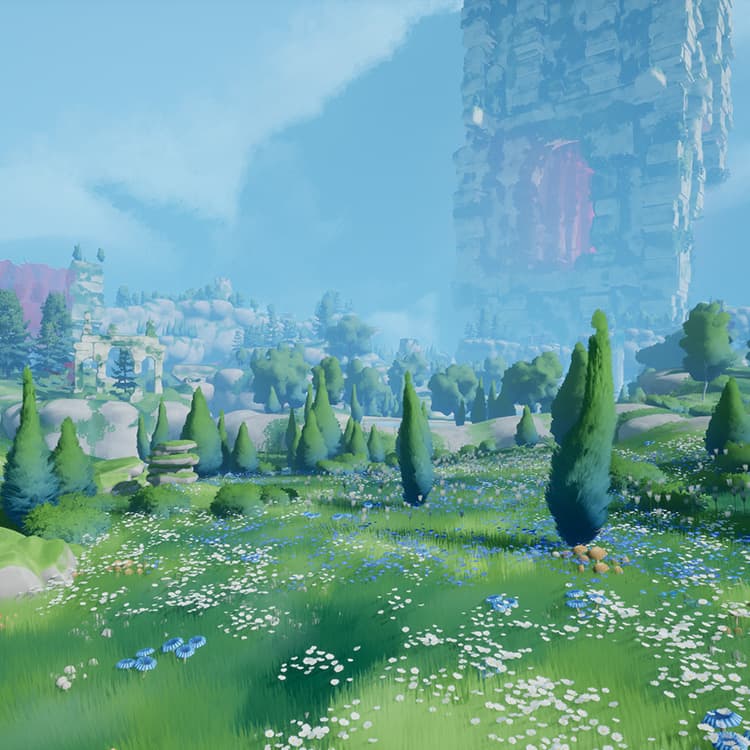
I started this long-term side project to build an entire game's art direction by myself, inspired by the Ghibli style
To get there, I worked on shading, modeling, texturing, lighting, and R&D across a wide range of assets
Most textures are grayscale, with gradients applied through material instances to create new biomes easily while reducing memory usage
The water uses the SingleLayerWater shading model, as it provides lower-cost translucency and lighting results than a traditional translucent material
It is made of multiple layers: glitter, coastal foam, caustics, and refraction
Here are all the different vegetation assets and how they were made:
But also some non-vegetation assets that include:
All ground-based foliage is derived from a master shader that can be influenced by a character-based render target with various factors
The actual render target is an RG 8-bit texture, which could be reduced further in resolution
Some of the vegetation like Grass, Reed or Elephant Grass are bending based on their instance pivot point and for vegetation like Mushrooms, Wheat or Flowers they also have their local pivot point baked in the mesh data for an accurate world position offset
These islands were entirely generated from Houdini and include LODs, collision, and ivy vegetation instances on the edges to help with blending
I had to find a way to scatter vegetation easily on every mesh, so I used Procedural Foliage Spawner, which can mask scattered vegetation based on vertex color
Vertex color also helps determine whether a surface is rock, sand, or grass (I can't just use a top dot product mask)
As the base island shader uses triplanar mapping for the rock layer and top-down projection for grass and sand, I baked the island "height" into the UVs for the fake gradient and shadow effect (which avoids using the BoundingBoxBased_0-1_UVW node)
Just like floating islands, waterfalls are also 100% Houdini-generated and spline-driven, so they can be dynamically shaped to fit specific layouts